

Geophysical Studies
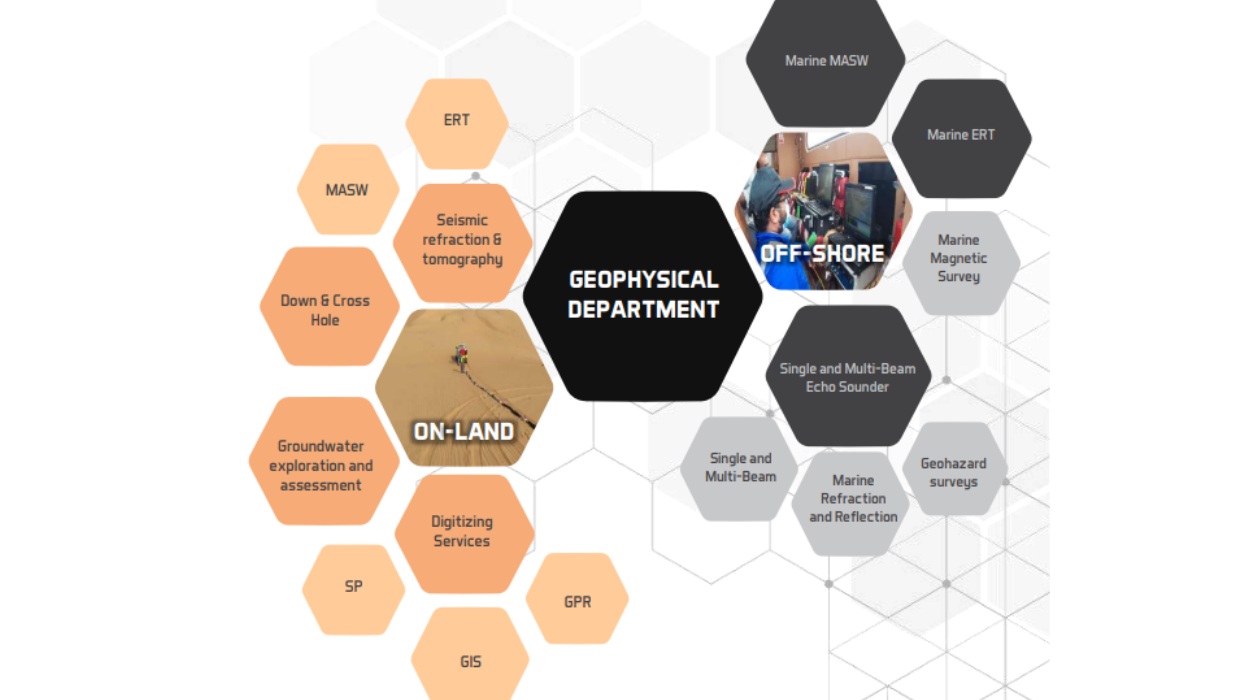
Geophysical surveys can provide accurate and instant answers to questions with a minimum amount of disturbance to the surface of a site. In essence, geophysics allows you to “see below the surface” without having to excavate large areas or drill an inordinate number of boreholes.
Gulf Survey Geophysical Department Provides wide range of geophysical applications and services to clients, who seek for noninvasive, surface-based ground investigations, which could identify subsurface distribution of geologic material, water resources, and contaminated zones, allocating potential natural hazards such as faults, karstic, cavity, major fractures, and failure features.
Using state-of science in geophysical instrumentation, and data processing methods (including joint inversions), Gulf Survey can rapidly and accurately locate, map, and interpret subsurface features and anomalies.
ONSHORE GEOPHYSICAL SERVICES
- Multichannel analysis of surface waves (MASW)
- Seismic refraction & tomography
- Borehole seismic methods including tomography (downhole and cross hole testing)
- Self-potential (SP) • Electrical resistivity tomography (ERT)
- Geographic Information System (GIS)
- VSP and check shot seismic
- Ground penetrating radar (GPR)
- Groundwater exploration and assessment.
- Vibration Monitoring
- Digitizing Services
OFFSHORE GEOPHYSICAL SERVICES
- Marine Multichannel analysis of surface waves (Marine MASW)
- Marine Electrical Resistivity Tomography (Marine ERT)
- Marine Magnetic Survey
- Marine Refraction and Reflection
- Single and Multi-Beam Echo Sounder
- Geohazard survey
ENGINEERING/GEOLOGICAL APPLICATIONS OF GEOPHYSICS
- Depth-to-bedrock, or thickness of an overburden.
- Geometry of bedrock.
- Competency of bedrock – for foundation design or excavation needs (e.g., rip ability).
- Lateral variability of soil stiffness
- Vertical variability of soil stiffness
- Low-strain elastic constants
- Presence of faults.
- Depth to water table.
- Dam stability.
- Dam seepage.
- Levee assessment.
- Foundation and/or abutment characteristics for dams and levees.
- IBC Site Classification – Vs30 (meters).
- Identify Construction Obstacles – pipelines, cut-off walls, MSE walls, or utilities.
- Landslide and slope monitoring; slide plane detection
- Karst – in limestone and dissolution in gypseous bedrock settings
- Lithologic changes – lateral and vertical, particularly in soil deposits
- Reuse of foundations – particularly for bridges.
- Man-induced collapse features (engineering failures).
- Quality control for ground improvement (e.g., DDC, soil-mix columns, or jet grouting)
- 1D, 2D or 3D assessment of small or large sites for geologic anomalies
- Permafrost thickness and stiffness
ENVIRONMENTAL APPLICATIONS OF GEOPHYSICS
- Spills or Free Product in the shallow subsurface
- Abandoned oil wells • Lateral delineation of historic landfills
- Vertical imaging of landfill thickness
- Time lapse monitoring (4D) investigation for flow movement
- Abandoned and covered / buried mud pits from oil well drilling
- Unknown geologic conditions (e.g., karst, faults, dipping layers)
- Time lapse monitoring (4D) investigation for flow movement
- Abandoned Mine Lands (AML) – both coal and hard rock
- Leak detection for liners
- Acid Mine Drainage